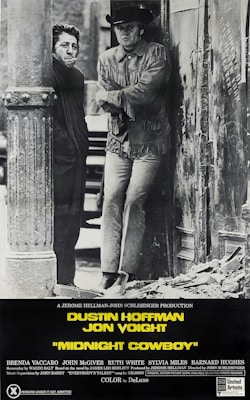
Last night, I finally got around to watching the iconic 1969 film “Midnight Cowboy” with Dustin Hoffman and Jon Voight on the MGM streaming service via Amazon Prime. This film was initially rated “R” but United Artists’ executives revised this rating to “X” because of the homosexual references not considered appropriate at that time. In 1971, the film was re-rated “R”.
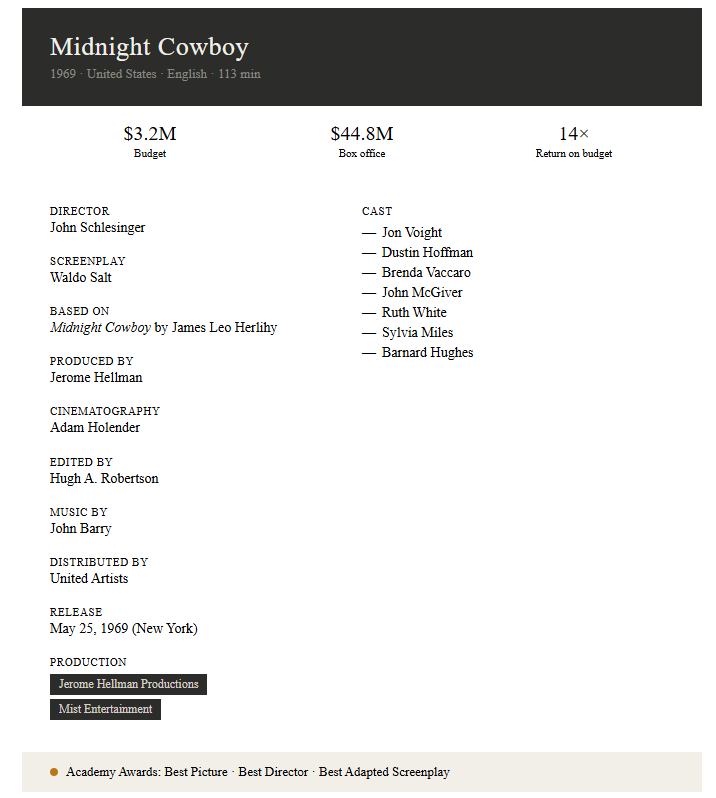
Midnight Cowboy is a 1969 American drama directed by British filmmaker John Schlesinger. Waldo Salt adapted the screenplay from the 1965 James Leo Herlihy novel of the same name. Additionally, when the opening credits begin, you hear that familiar song “Everybody’s Talkin'” — written by Fred Neil and performed by Harry Nilsson. This song sets the theme for the main character’s journey from rural Texas to the bright lights of New York City.
The main actors are Dustin Hoffman and Jon Voight. They play hustlers who become unlikely friends in New York City. Voight’s character, Joe Buck is a male prostitute who was raised by his maternal grandmother after his mother abandoned him. Hoffman plays “Ratso” or Enrico Salvatore “Rico” Rizzo, a small-time conman and former shoe-shine guy.
Developing the storyline
The reasons for Joe Buck’s drift into prostitution are never fully explained — he fell into the profession partly because of his good looks and easy ability to attract both women and men. Joe Buck isn’t depicted as gay, though the film leaves room for ambiguity. His sketchy, traumatic early life — beginning with his mother’s abandonment when he was a small child and a fragmented, disturbing upbringing with his religious grandmother — clearly shapes the man he becomes.
As a young adult he meets and falls in love with Annie (played by Jennifer Salt). A series of flashbacks shows the couple together romantically when they are set upon by a gang who rape both Joe and Annie. This violent experience appears to contribute to Joe’s feelings of ambivalence about his own sexuality, even as he offers himself to male clients for money.
The film opened in May 1969. Voight was 30 at the time. Hoffman was 31. Both look remarkably young on screen. Yet Hoffman’s Ratso Rizzo — sick, grimy, and world-weary — seems decades older.
Midnight Cowboy — the story
The film opens with the hapless Joe Buck (Voight) quitting his job as a dishwasher in a rural Texan diner. Dressed in full cowboy attire, he travels by bus to New York City intending to work as a male prostitute, chatting openly to fellow passengers about his plans along the way.
When asked if’s he’s a cowboy, Joe Buck says, “Well, I’ll tell you the truth now. I ain’t a for-real cowboy, but I am one hell of a stud!”
Arriving in New York, he clumsily attempts to seduce a middle-aged woman, Cass, in her Park Avenue apartment. The next morning, when he asks her for money, she acts insulted, produces an empty purse, and brazenly asks to borrow money from him instead. He capitulates — giving her bus fare despite having very limited funds of his own.
Meeting Ratso Rizzo
Wandering the city, he encounters Rico “Ratso” Rizzo, a homeless con man with a crippled leg, expertly played by Dustin Hoffman. Ratso connects Joe with a potential client but pockets $20 for his “expenses”. The client turns out to be a mentally unstable religious fanatic. Joe then spends his days drifting through the streets of New York, listening to his Zenith portable radio and searching fruitlessly for Rico.
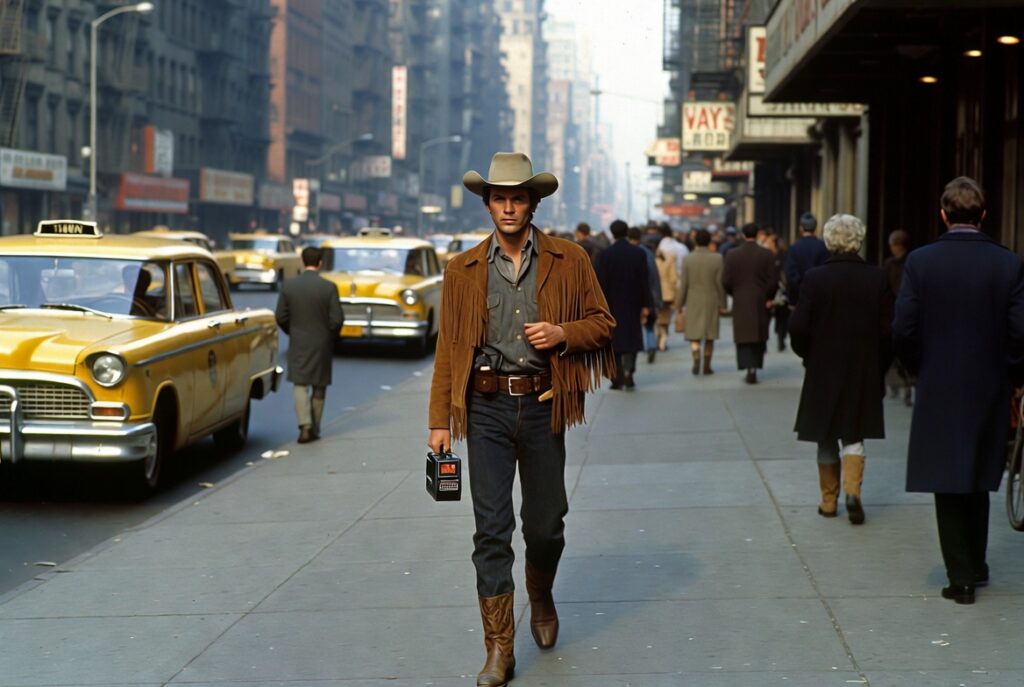
In a desperate attempt to make money, Joe has a sexual encounter with a young man in a movie theatre — but receives no payment. Voight conveys the discomfort of the scene wordlessly, intercut with flashbacks to the earlier rape in Texas.
By now evicted from his hotel and unable to retrieve his belongings, Joe tracks down Rico again. The two end up sharing a condemned squat, where they see out the rest of the year scraping together whatever resources they can. The apartment’s grimy Florida travel posters hint at Rico’s dream of escaping south to warmer weather.
As the story progresses, it becomes clear that Rico is suffering from a serious lung condition — a fate he links to his father, a shoeshine man who developed lung damage from years of inhaling shoe polish.
From the Factory to Florida
The middle section of the film further develops the friendship between the two protagonists. While in a coffee shop, the handsome Joe Buck catches the attention of Andy Warhol-adjacent filmmakers. In this scene, Joe (but not Rico) is invited to a psychedelic party hosted by Warhol fans.
There’s some humorous moments in this interlude as Ratso observes there’s a lot of whackos at the party. Joe is offered and takes psychadelics from partygoers. It’s here that he meets another wealthy woman, Shirley, played by a young Brenda Vaccaro who propositions him for sex. He is unable to initially perform sexually and she mocks him — but pays him anyway. There’s a scene where they play Scribbage and a reference to the Mony building where Joe mispells “money”.
Joe returns to the squat to find Rico gravely ill. Rico refuses medical help. He instead pleads with Joe to get them both on a bus to Miami. Joe picks up another man and they return to his hotel room. The man offers only $10. Joe flies into a rage, beats him severely and takes $57 in cash. This is just enough for two bus tickets to Florida.
The final act follows both men on the long bus journey south. At a rest stop, Joe buys new clothes for them both. His cowboy outfit goes in the bin. This simple act shows us that he has left his hustling (artificial cowboy) life behind. Back on the bus, Joe tells Rico he plans to find honest work in Miami. Tragically, it’s only then that he realises Rico has died in the seat beside him just as the bus pulls into the outer suburbs of Miami. This is undoubtedly one of the most poignant endings in American cinema.
Production notes
On location — Texas
Filming began in Big Spring, Texas in 1968. In the initial scenes, as Joe’s bus rolls east, the camera picks out a roadside billboard: “If you don’t have an oil well…get one!” Interestingly, this was a real advertisement for Eddie Chiles’ Western Company of North America. Signs like it were common across the Southwest through the late 1960s and into the 1970s.
New York locations
Joe stays at the Hotel Claridge on the southeast corner of Broadway and West 44th Street in Midtown Manhattan. His room overlooks Times Square. The building was designed by D. H. Burnham & Company and opened in 1911. It was demolished in 1972 — just three years after the film’s release.
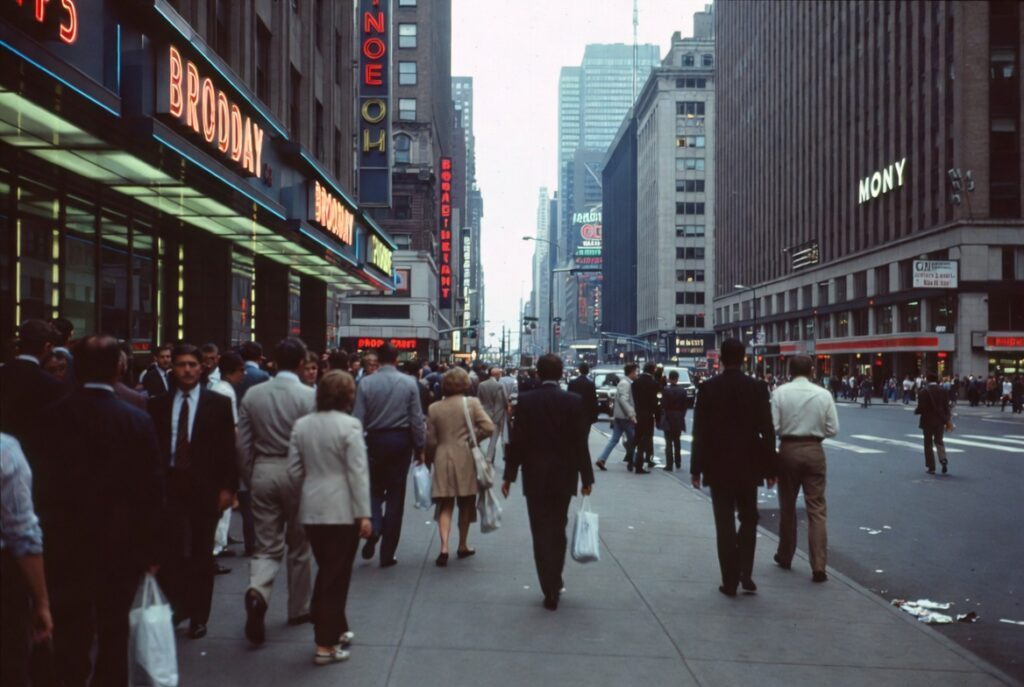
In addition, the illuminated weather sign atop the Mutual of New York (MONY) Building at 1740 Broadway appears three times in the New York sequences. It gets its best moment in the Scribbage scene with socialite Shirley. Joe misspells the word “money” — and his spelling matches the sign exactly.
Casting
Meanwhile, the casting reflects a cool irony. Dustin Hoffman — who plays a man hardened by New York’s streets — is from Los Angeles. Jon Voight — whose character stumbles through the city as a wide-eyed outsider — is a native New Yorker from Yonkers. Significantly, Voight willingly agreed to the Screen Actors Guild minimum rate to secure the role. Well before Star Wars, Harrison Ford also unsuccessfully auditioned for the role of Joe Buck. John Schlesinger’s first choice for Joe Buck was Michael Sarrazin. However, Sarrazin knocked back the role because of existing obligations with Universal Studios.
Andy Warhol’s influence
Evidently, Schlesinger and producer Jerome Hellman had originally approached Andy Warhol to appear as an underground filmmaker, but Warhol declined and suggested his superstar Viva in his place. Accordingly the centrepiece scene — a wild, Factory-esque party — was populated by Warhol’s extended circle of superstars, recruited as extras. In addition, the set was dressed with original Warhol artworks on loan from the Museum of Modern Art. It was filmed at Filmways Studios in East Harlem. During filming however, Andy Warhol himself was hospitalised, recovering from an assassination attempt.
Pop culture legacy
- Rizzo the Rat, a beloved character from The Muppets, takes his name from Dustin Hoffman’s character Ratso Rizzo.
- Seinfeld affectionately references the the film’s devastating final bus scene in the episode “The Mom and Pop Store,” where Jon Voight appears as a guest, playing himself.
- In 2022, director Nancy Buirski released the documentary “Desperate Souls, Dark City and the Legend of Midnight Cowboy.“
- In 1994, the Library of Congress selected Midnight Cowboy for permanent preservation in the US National Film Registry, deeming it “culturally, historically, or aesthetically significant.”
- In one of the film’s most iconic scenes, Dustin Hoffman says: “I’m walkin’ here!”. That quote is now listed at number 27 on AFI’s 100 Years – 100 Movie Quotes.