

I first discovered Breaking Bad around 2012 when the series was almost completed after a solid recommendation from a friend. Because the storyline sounded so quirky, I started watching it on SBS (in Australia). Addicted to the show, I later ordered the entire DVD collection from my local library.
Breaking Bad tells the story of Walter White, a financially struggling high‑school chemistry teacher in Albuquerque who develops inoperable stage‑three lung cancer. Determined to secure his family’s future and using his extensive chemistry knowledge, he decides to begin manufacturing methamphetamine with his former student, Jesse Pinkman, using a mobile drug lab. Their operation quickly grows as Walter’s exceptionally pure blue meth becomes highly sought after. Operating under the alias “Heisenberg,” Walter enters an unfamiliar and increasingly dangerous criminal underworld.
As the story evolves, Walter manages his double life while clashing with his family, principally his wife and later his DEA brother-in-law, Hank Schrader. The story takes place from 2008 until 2010 during which Walter and Jesse Pinkman build a methamphetamine drug empire, initially in a hapless fashion. Later on, their methods become more professional and they become entangled with local dealers, gangs, regional distributors and Mexican cartels.
Breaking Bad was a sleeper hit when it first premiered on AMC in January 2008, despite receiving overwhelmingly positive reviews, it had initially modest viewership. By the fourth season, the show started streaming on Netflix reaching much larger audiences and viewership exploded from then on.
Critics have widely regarded the show as one of the greatest television shows of all time. In September 2026, The New York Times made a list of “The 100 Best Shows of the 21st Century”. It ranked “Breaking Bad” as number one.
Why Breaking Bad still dominates the Streaming Landscape
I recently rewatched the series for the third time – all five seasons and it stands the test of time. I believe this is because the show contains core tragic Shakespearean elements. Walter White is the tragic hero – a chemistry genius who possesses greatness but ultimately suffers a catastrophic downfall. His fatal flaw is pride which drives him towards his ultimate ruin.
Breaking Bad uses conflict by combining the characters’ internal psychological struggles with their personal journeys. The storyline then visualises those struggles alongside external opposition from business rivals and their families. There is a sense of tragic waste where both good and bad characters are destroyed either in a spiritual or a literal sense. The senseless deaths of Hank Schrader (and his partner, Steve Gomez), Mike Ehrmantraut, Combo (killed by a child) and the teenage boy bystander (Drew Sharpe) in later seasons are perfect examples. The spiritual decline of both Walter White and Jesse Pinkman – albeit – in quite different ways – are also relevant here.
The audience’s initial sympathy with downtrodden Walter White turns to loathing as the show evolves. We also feel sympathy with DEA agent Hank as we see him put head to head with Walter White – who by now has become the show’s villain.
Better Call Saul
Comic relief is provided principally by criminal lawyer (and lawyer for criminals), Saul Goodman (who has some of the best lines in the show) and to a lesser extent by Jesse Pinkman’s friends – Skinny Pete and Badger.
The show also skilfully captures the character arcs of both its main and supporting characters. After discovering the extent of Walter’s growing criminal empire, his wife, Skyler, one of the most disliked characters in the series, suggests that Walter deal with Jesse Pinkman when he becomes a liability in Season 5, Episode 12, “Rabid Dog”. Her moral compass shifts with the story timeline and as the violence escalates.
Breaking Bad – shot on location in Albuquerque, New Mexico
The show’s creators initially planned to set Breaking Bad in California. However, after careful consideration they later moved the show to Albuquerque, New Mexico which had more favourable tax incentives. What was initially a financial decision though, ultimately created the unique flavour of the show. Both the cinematography and the music score framed the story to give it the neo-Western style that it’s famous for.
Showrunner, Vince Gilligan, interviewed in 2013 says about the show’s iconic location:
“Albuquerque has meant the world for Breaking Bad. I can’t imagine Breaking Bad being anywhere else. I can’t imagine the show would be nearly as interesting as it is if it were set anywhere else. Just the cinematography and the look of the show. When I think of Albuquerque, I think of clouds, just those beautiful floating cumulus clouds. The skies. These are skies you just don’t see in Southern California. You really get the depth and the sense of scale in the desert in Albuquerque.” [Source – Bill Nevins, Albuquerque The Magazine, Interview with Vince Gilligan, 27 March 2013]
Breaking Bad – the Pilot – setting the scene
The pilot episode introduces viewers to Walter White, a brilliant, yet overqualified middle-aged high school chemistry teacher. Walt works a second job as a cashier at a car wash to keep his family financially afloat. At the car wash, he encounters his students who openly mock him as he wipes down an expensive sports car.
Walter reluctantly celebrates his 50th birthday hosted by his pregnant wife. Walter White is the quintessential middle-class white man having a midlife crisis. His younger wife is pregnant with their second child. His teenage son, Walter Jnr (Flynn) has cerebral palsy – played by the perfectly cast, late R J Mitte – who has the same disability.
During Walt’s 50th birthday party, viewers meet his alpha-male DEA-agent brother-in-law, Hank Schrader. At the party, Schrader shows a news report of his latest drug bust, where the DEA seizes $700,000 in illegal drug money. Walt appears politely curious, and Hank offers to take him on a ride-along to a drug bust.
The following day, Walter collapses at the car wash and is taken by ambulance to hospital. He protests telling the ambulance driver that his health insurance won’t cover this. In the hospital, he is given a diagnosis of inoperable lung cancer with at most two years to live. Walter keeps this news from his family.
The DEA ride-along – meeting Jesse Pinkman
Walter then takes up Hank’s offer of a ride-along to a DEA drug bust which coincides perfectly with his knowledge of his terminal cancer diagnosis. Walter is well aware that with his extensive chemistry background he can easily develop a recipe for cooking meth.
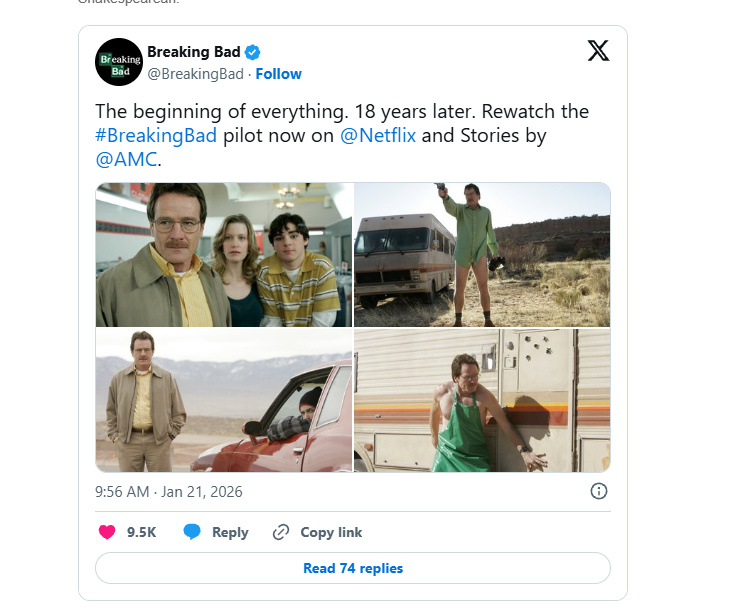
On his ride-along with Hank, Walt sees one of his former students, Jesse Pinkman (Captain Cook) escaping from a neighbour’s house. He immediately realises that Pinkman is the meth cook that the DEA are looking for. Later that day Walter goes to Pinkman’s house and suggests that they go into business together.
The audience gets the first inkling of Walter White’s manipulative character when he starts by blackmailing Jesse Pinkman into agreeing to cook meth with him. Otherwise he’ll tell his DEA agent brother-in-law of Pinkman’s role in the drug seizure earlier that day.
From Anti-Hero to Villain
Walter’s character is an overt narcissist and this is apparent from the first few episodes. He always insists on getting his way and when he doesn’t he will then gaslight other players until they agree to his path forward.
His narcissism and psychopathy increase as the story develops. By Seasons 3-4 – Walter White’s descent into unredeemable evil is apparent. This is where audiences start to dislike him. At the same time, the audience’s sympathy shifts towards other characters like Jesse Pinkman, Mike Ehrmantraut and Saul Goodman – who all suffer as a result of bad decisions made by Walter White.
The tragic character arc of Walter White
The character arc of Walter White begins with his struggles working as an underpaid and largely unrecognised and marginalised chemistry teacher. Even though by now, it’s clear that he has genius level intelligence. Walter’s backstory includes his pivotal role in the development of a now billionaire dollar startup, Gray Matter Technologies where Walter worked with Gretchen and Elliot Schwartz decades earlier.
Before the main story of Breaking Bad begins, we learn in a series of flashbacks that Walter ended up selling his stake in the company for $5,000 dollars to cover rent and living expenses at an earlier stage in his marriage. After the company’s explosive success, Walter continues to obsessively track its soaring stock valuation. This is a constant reminder of the success he could have had, but didn’t because of one bad business decision.
After his initial cancer diagnosis, while Walter is beginning to make money from his growing methamphetamine business, he decides to pretend that Gretchen and Elliot are funding his cancer treatment, when in fact his drug money is covering this. His resentment about giving credit to Gretchen and Elliot for saving his life is considerable – particularly given his ongoing resentment about their success which he contributed to but received no real reward. He delivers karmic payback to them in the final episode of Season 5 when he forces them to give his drug money to his family anonymously to avoid DEA-seizure.
Becoming Heisenberg
Walter’s key character flaw is his pride and Vince Gilligan develops this skilfully. As the series progressed, Gilligan and his writing team made Walter increasingly unlikeable to audiences. Gilligan said that Walter White went from “being a protagonist to an antagonist.” [Source: Scott Bowles, (July 13, 2011). “‘Breaking Bad’ Shows Man at His Worst in Season 4”. USA Today].
This shift is significant. It was also reflected in Walter’s growing confidence and power amongst his rivals in the methamphetamine business. By Season 5, Walter tells Jesse, “Jesse, you asked me if I was in the meth business or the money business. Neither. I’m in the empire business.” (Breaking Bad, Season 5, Episode 6, “Buyout”).
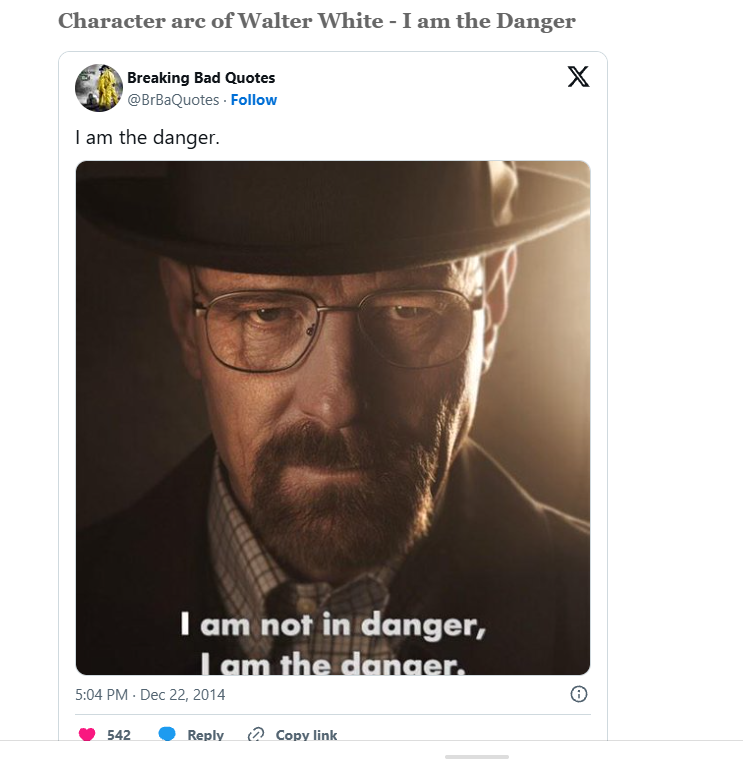
Walter morphs into Heisenberg in Season 1, episode 6, “Crazy Handful of Nothin’”. He introduces himself to Tuco Salamanca as “Heisenberg” (a famous German theoretical physicist who pioneered quantum mechanics). By Season 5, Episode 7, Walter powerfully says to drug rival, Declan: “Say my Name”. Declan realises that Walter is Heisenberg. He agrees to Heisenberg’s terms for the meth distribution. In this same episode, Walt unflinchingly kills his co-worker (fixer), Mike Ehrmantrout. He does this to obtain the names of the nine men in prison who could possibly testify against them. While Mike is dying, Walt realises that he could have gotten those names from Lydia Rodarte-Quayle. Walter’s moral downfall is now almost complete.
Key supporting characters who elevated the narrative
Walter White’s Universe
- Skyler White (Anna Gunn) — Walter’s younger pregnant wife, navigating the growing fractures in their marriage.
- Walter Jr. (Flynn) (R J Mitte) — Walter’s teenage son, living with cerebral palsy and unaware of his father’s criminal descent.
- Hank Schrader (Dean Norris) — Walter’s brother‑in‑law, a brash but skilled DEA agent whose investigation obsessively focuses on capturing Heisenberg.
- Marie Schrader (Betsy Brandt) — Hank’s ditzy wife and Skyler’s sister, often entangled in the family’s emotional fallout.
- Gretchen and Elliot Schwartz (Jessica Hecht and Adam Godley) — Walter’s smug former business partners at Gray Matter Technologies. They represent the life and success he believes he lost.
Jesse Pinkman’s world
- Skinny Pete (Charles Baker) — Long‑time friend and low‑level dealer who remains loyal throughout the series.
- Brandon “Badger” Mayhew (Matt Jones) — Jesse’s goofy but good‑hearted friend and occasional partner in crime.
- Christian “Combo” Ortega (Rodney Rush) — Friend and business associate whose death becomes a turning point for Jesse.
- Jane Margolis (Krysten Ritter) — Jesse’s landlord and love interest, a recovering heroin addict whose relapse and death devastate him.
- Andrea Cantillo (Emily Rios) – love interest and recovering meth addict and single mother to a young boy, Brock. Executed by Todd in Season 5, episode 15 – as punishment for Jesse’s escape attempt from Jack Welker’s drug compound.
Walter White’s Necessary Henchmen (and Women)
- Saul Goodman (Bob Odenkirk) — Criminal lawyer, fixer, and money‑launderer who becomes indispensable to Walter’s operation.
- Mike Ehrmantrout (Jonathan Banks) — Former Philadelphia police officer turned enforcer and problem‑solver, working for Gus and later reluctantly with Walter.
- Lydia Rodarte‑Quayle (Laura Fraser) — Sociopathic Madrigal executive who expands the meth distribution network and becomes entangled in Walter’s empire.
- Todd Alquist (Jesse Plemons) — Polite, soft‑spoken sociopath whose loyalty to Walter masks extreme violence.
Villains
- Crazy Eight – aka – Domingo Gallardo Molina – (Max Arciniega) – Fake DEA informant and drug distributor reluctantly killed by Walter in Season 1. He reappears in Better Call Saul with a more fleshed out character.
- Tuco Salamanca (Raymond Cruz) — Volatile cartel lieutenant whose unpredictability sets early stakes for Walter and Jesse.
- The Salamanca Twins (Leonel and Marco) (Luis Moncado & Daniel Moncado) — Silent cartel assassins driven by family loyalty and vengeance.
- Hector Salamanca (Mark Margolis) — Former cartel boss, now incapacitated, whose hatred fuels key turning points.
- Gus Fring (Giancarlo Esposito) — Meticulous, calculating drug kingpin whose empire becomes both opportunity and threat for Walter.
- Todd Alquist (Jesse Plemons) — Also a villain in his own right (see above).
- Jack Welker (Michael Bowen) — Todd’s uncle, leader of a violent white‑supremacist gang who becomes the final major antagonist.
Critical acclaim and Awards
After the final powerful episode of Season 5, “Felina” of Breaking Bad aired in 2013, it has consistently been ranked among the greatest television dramas ever produced. Critics praised creator Vince Gilligan’s meticulous storytelling, engaging writing and the show’s moral complexity.
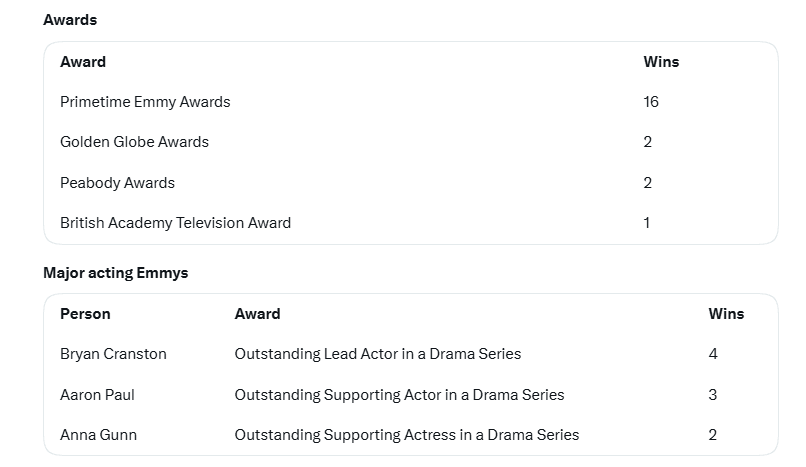
The show’s excellence was recognised across the television industry and garnered an extraordinary collection of awards. During its run, Breaking Bad earned 16 Primetime Emmy Awards, two Golden Globes, two Peabody Awards, and a British Academy Television Award.
The show’s final season received overwhelming critical praise, with many commentators describing it as one of the strongest conclusions in television history. The combination of exceptional writing, cinematic visual style, and consistently outstanding performances helped elevate the series from a cult favorite to a global phenomenon.
Much of the show’s award success was driven by its cast. Bryan Cranston received four Primetime Emmy Awards for Outstanding Lead Actor in a Drama Series. His powerful portrayal of Walter White cemented his place among television’s most celebrated actors.
Aaron Paul’s performance as Jesse Pinkman also earned widespread recognition. He won the Primetime Emmy Award for Outstanding Supporting Actor in a Drama Series three times. Meanwhile, Anna Gunn received two Emmy Awards for Outstanding Supporting Actress for her nuanced portrayal of Skyler White.
Together, the cast brought an exceptional level of depth and authenticity to the series. This prompted veteran actor, Anthony Hopkins to write a lengthy tribute piece praising the show and Bryan Cranston, in particular.
Anthony Hopkins’ tribute to Bryan Cranston
After binge-watching Breaking Bad, Academy Award-winning actor Anthony Hopkins publicly praised Bryan Cranston’s performance in a fan letter. In the letter, sent shortly after the show’s conclusion, Hopkins described Cranston’s portrayal of Walter White as “the best acting I have seen, ever” and called the series itself “brilliant.”
Hopkins compared Breaking Bad to a Shakespearean or Greek tragedy. He praised not only Cranston but also the show’s writing, direction, cinematography, and ensemble cast. For many fans, Hopkins’ endorsement served as the ultimate validation of the show’s artistic achievement.
Vince Gilligan and The X-Files Connection
Breaking Bad showrunner Vince Gilligan built his career working as a writer for several seasons of The X-Files. Before Gilligan cast Bryan Cranston for the main role of Walter White, he had previously worked with Cranston on an episode from Season 6 of The X-Files – “Drive”. In that episode, Cranston plays the role of an anti-Semite with a terminal illness who takes the main character, Fox Mulder hostage. Based on that performance, Gilligan was convinced that Bryan Cranston could credibly play the Walter White part with an equal combination of narcissism and empathy.
Actor Aaron Paul, who plays Jesse Pinkman, previously guest starred in Season 5 of The X-Files in the episode “Lord of the Flies”. Vince Gilligan recalled Aaron Paul’s earlier performance in that show and was similarly impressed with his audition for Breaking Bad. Despite this, Gilligan had initially intended to kill off the Jesse Pinkman character by the end of the first season. However, he reversed this position shortly after filming the first episode. After seeing Aaron Paul’s compelling performance in the Pilot, Gilligan understood that it would be “a huge, colossal mistake, to kill off Jesse”. [Source: Breaking Bad – Aaron Paul Almost Got Killed Off (Paley Interview), The Paley Center for Media, 4 March 2010.] And one of the key driving themes of the show is the close (almost co-dependent) relationship between Walter and Jesse and how that evolves over time.
Final Thoughts
Shows like Breaking Bad resonate with audiences because they depict characters wrestling with moral dilemmas and making bad choices. They are somehow rewarded for these, at least initially, only to face consequences episodes later on. There is also the absence of poetic justice some of the time where outcomes don’t always neatly reward virtue or punish bad behaviour.
The New York Times piece on the show, written in 2010, noted that “Breaking Bad takes place in a universe where nobody gets away with anything and karma is the great uncredited player in the cast.” [Source: The New York Times, “The Dark Art of Breaking Bad”]
Importantly, Breaking Bad which was written and produced from 2008 until 2013 has virtually none of the woke, virtue-signalling elements present in modern cinema. No excuses are made for its villains. We can understand how they got to the point in their story but we don’t pretend that their behaviour is morally explainable. Breaking Bad continues to attract new audiences through streaming platforms (now Netflix). Breaking Bad remains a frequent reference point in discussions about peak television.